About This Course
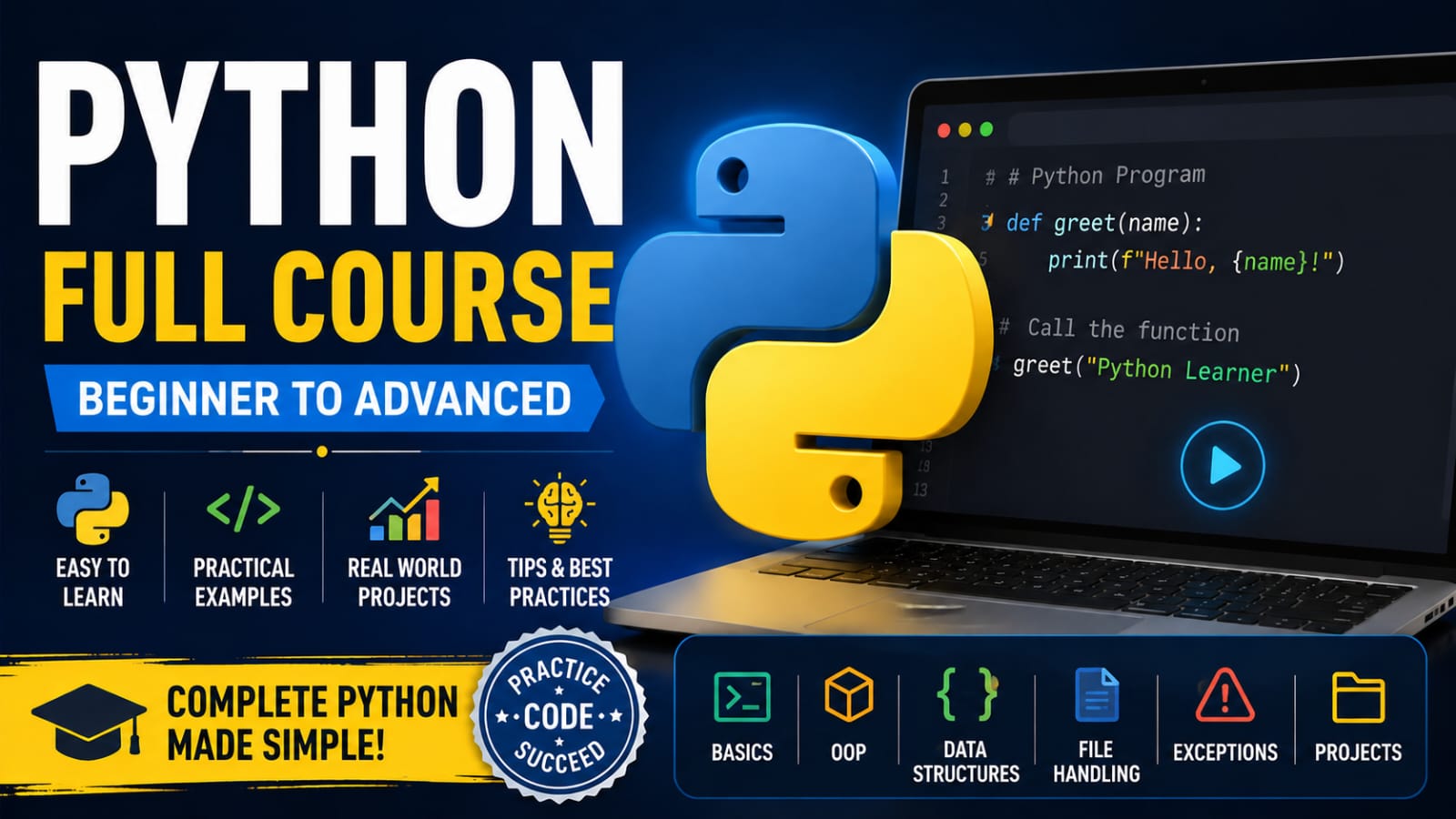
The Python course is designed for beginners, students, job seekers, and aspiring software developers who want to build a strong foundation in programming. The course covers Python fundamentals, variables, data types, operators, control statements, loops, functions, strings, lists, tuples, dictionaries, sets, object-oriented programming (OOP), modules, packages, file handling, exception handling, and database connectivity. Participants will gain hands-on experience by developing real-world projects while learning industry-standard coding practices and problem-solving techniques. The course also introduces Python applications in web development using frameworks like Django and Flask, automation and scripting, data analysis, artificial intelligence (AI), machine learning, data science, and API development. By the end of the course, learners will have the practical skills and confidence to design, develop, test, and deploy professional Python applications, preparing them for careers in software development, automation, data analytics, AI, and full-stack development.
Course Curriculum
11 modules
Learn Python from scratch, including installation, syntax, variables, data types, input/output, and operators.
Key topics: Python installation, IDE setup, comments, variables, type conversion, input/output statements, arithmetic and logical operators.
Lessons will be added soon.
Teach students how to control program execution and repeat tasks efficiently.
Key topics: if, elif, else, nested conditions, for loops, while loops, range(), break, continue, pass, nested loops, and pattern programs.
Lessons will be added soon.
Understand how to store, access, update, and organize multiple values.
Key topics: strings, lists, tuples, sets, dictionaries, indexing, slicing, built-in methods, mutability, and nested data structures.
Lessons will be added soon.
Teach students to write reusable, organized, and maintainable programs.
Key topics: defining and calling functions, parameters, arguments, return values, default arguments, keyword arguments, *args, **kwargs, scope, lambda functions, and recursion.
Lessons will be added soon.
Build logical thinking through string manipulation and common programming problems.
Key topics: string methods, formatting, searching, replacing, splitting, joining, palindrome checking, anagrams, counting characters, and basic algorithmic thinking.
Lessons will be added soon.
Teach students how to read, write, store, and process information in files.
Key topics: opening and closing files, read/write/append modes, with statement, text files, CSV files, JSON files, file paths, and file operations.
Lessons will be added soon.
Help students write reliable programs that handle errors without crashing unexpectedly.
Key topics: syntax errors versus exceptions, try, except, else, finally, raising exceptions, custom exceptions, debugging, and error messages.
Lessons will be added soon.
Show students how to organize code and reuse Python's built-in functionality.
Key topics: import statements, built-in modules, creating custom modules, packages, pip, virtual environments, standard library, and commonly used libraries such as math, random, datetime, and os.
Lessons will be added soon.
Introduce useful language features that make Python programs more expressive and efficient.
Key topics: list/dictionary/set comprehensions, iterators, generators, decorators, closures, map(), filter(), zip(), enumerate(), and unpacking.
Lessons will be added soon.
Develop problem-solving skills and introduce practices used to verify program correctness.
Key topics: searching, sorting, linear and binary search, basic time complexity, stacks, queues, linked-list concepts, assertions, unit testing with unittest, and debugging techniques.
Lessons will be added soon.
Combine the concepts learned throughout the course into working Python programs.
Key topics: project planning, writing modular code, debugging, testing, code organization, common Python interview questions, coding exercises, and project demonstrations.
Lessons will be added soon.